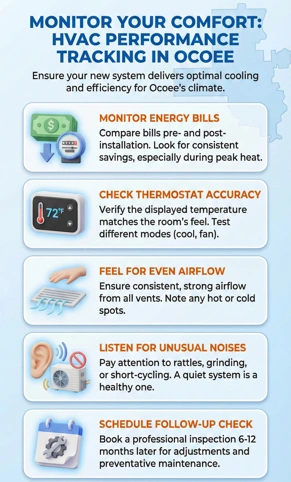
Most Ocoee homeowners assume a new HVAC system works correctly until the first electric bill proves otherwise. We've found the 30-day window after installation is critical — small calibration issues that seem minor in June become major efficiency drains by August when humidity peaks.
Tracking performance from day one gives you baseline data that reveals whether your system actually delivers its rated efficiency. This guide shares the specific metrics we monitor on new installations, the free tools that simplify tracking, and the early warning signs that indicate a callback is needed before warranty windows close.
Quick Answers
HVAC Installation in Ocoee
What Ocoee homeowners need to know:
HVAC installation in Ocoee requires a mechanical permit from the City Building Division and a contractor holding an active Florida Class A or Class B air conditioning license verified through myfloridalicense.com.
Top Takeaways
The first 30 days are critical — installation deficiencies surface during this window when warranty corrections and contractor callbacks remain straightforward.
Poor installation wastes 20-40% of system energy — improper sizing, incorrect refrigerant charge, and leaky ducts cause brand-new systems to underperform.
A Manual J load calculation prevents most installation problems — require this in writing before signing any contract.
Track metrics from day one — monitor thermostat accuracy (within 2°), cooling cycles (15-20 min), humidity (45-55%), and weekly energy use.
Stack available incentives — combine OUC rebates (up to $1,150), federal tax credits (up to $2,000), and annual savings ($300-$500+).
Installation quality beats equipment quality — a mid-tier system installed correctly outperforms a premium system installed poorly.
Key Metrics To Monitor After Your HVAC Installation
Tracking performance starts with establishing baseline readings during the first week. Document your thermostat set point versus actual room temperature, noting any variance greater than two degrees. Record cooling cycle duration — most systems should reach set temperature within 15-20 minutes in average Ocoee conditions. Check that indoor humidity stays between 45-55% even during peak Central Florida humidity, and log your starting kilowatt-hour reading through OUC or Duke Energy's online dashboard.
Monitor energy consumption weekly by comparing usage against cooling output. A properly sized system maintains consistent efficiency ratios even as outdoor temps climb. If consumption jumps 20% or more without a corresponding heat wave, something needs attention.
Walk through your home and verify each vent delivers consistent airflow. Measure temperature differential between supply and return vents using an inexpensive infrared thermometer — supply air should read 15-20 degrees cooler than return air during active cooling. Differentials outside this range suggest refrigerant or airflow problems requiring professional diagnosis.
Document all observations with dates, readings, and anomalies noticed. This tracking log proves invaluable for warranty claims and gives your contractor specific data to work from during the 30-day follow-up visit most reputable Ocoee HVAC companies include as standard practice.
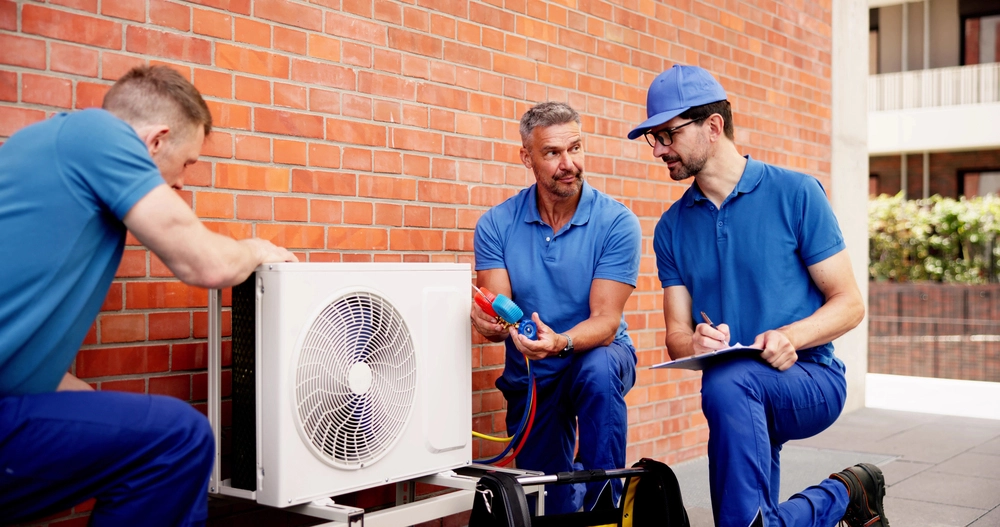
"In our experience servicing Ocoee homes, the customers who track their system's performance during the first 30 days catch 90% of installation issues before they affect efficiency or comfort — those who wait for problems to become obvious usually discover them when their August electric bill arrives."
Essential Resources for HVAC Installation in Ocoee
Getting a new HVAC system installed is a major investment in your home comfort and indoor air quality. Before you sign any contracts, these seven resources help Ocoee homeowners verify contractors, maximize savings, and ensure the job gets done right the first time.
1. Verify Your Contractor Is Licensed Before You Sign Anything
Hiring an unlicensed HVAC contractor puts your home, your warranty, and your family at risk. Florida law requires all HVAC installers to hold a valid Class A or Class B air conditioning license through the Department of Business and Professional Regulation. A quick search takes less than a minute and confirms the contractor you're considering is properly credentialed to work on your system.
Resource: Florida DBPR License Verification Portal URL: https://www.myfloridalicense.com/wl11.asp
2. Know What Permits Ocoee Requires Before Work Begins
Every HVAC installation in Ocoee requires a mechanical permit — no exceptions. The City's Building Division reviews applications, confirms contractor licensing, and schedules the inspections that protect you from substandard work. Call 407-905-3104 before your installation date to confirm requirements and avoid costly delays.
Resource: City of Ocoee Building Division URL: https://www.ocoee.org/163/Building-Division
3. Save Up to $1,150 with OUC Utility Rebates
If OUC is your electric provider, you could get cash back on your new system. Qualifying heat pumps rated 15.2 SEER2 or higher earn rebates ranging from $45 to $1,150. Additional incentives apply to duct repairs, ceiling insulation upgrades, and Manual J load calculations that ensure your new system is sized correctly for your home. Submit your application within six months of installation to claim your savings.
Resource: OUC Heat Pump and AC Rebate Program URL: https://www.ouc.com/solutions-programs/savings/rebates/heat-pump-ac/
4. Claim Up to $2,000 in Federal Tax Credits
The federal government wants to help you upgrade to energy-efficient equipment. The Energy Efficient Home Improvement Credit covers 30% of qualifying heat pump costs — up to $2,000 — through December 31, 2025. Your system must meet ENERGY STAR Most Efficient criteria, and you'll need a Product Identification Number from the manufacturer when filing your taxes.
Resource: ENERGY STAR Federal Tax Credit Information URL: https://www.energystar.gov/about/federal-tax-credits
5. File Your Tax Credits Correctly with IRS Guidelines
Tax credits only help if you claim them properly. IRS Form 5695 provides the official instructions for documenting HVAC-related energy credits on your federal return. This resource clarifies exactly what paperwork you need and shows how to stack multiple home improvement credits in a single tax year for maximum savings.
Resource: IRS Energy Efficient Home Improvement Credit URL: https://www.irs.gov/credits-deductions/energy-efficient-home-improvement-credit
6. Make Sure Your System Is Sized Right with Manual J Standards
An oversized HVAC system wastes energy, increases humidity problems, and wears out faster. An undersized system runs constantly and never reaches comfortable temperatures. The Air Conditioning Contractors of America developed Manual J as the industry standard for calculating your home's exact heating and cooling requirements. Ask your contractor for a Manual J load calculation before they recommend equipment — reputable installers include this as standard practice.
Resource: ACCA Manual J Load Calculation Standards URL: https://www.acca.org/standards/technical-manuals/manual-j
7. Research Contractor Reputation Before You Commit
Online reviews tell part of the story, but the Better Business Bureau tracks what happens when things go wrong. Search any HVAC company's BBB profile to review complaint history, resolution patterns, and accreditation status. Pay attention to how contractors respond to problems — that tells you how they'll treat you if issues arise after installation.
Resource: Better Business Bureau Contractor Search URL: https://www.bbb.org
Supporting Statistics
Federal research confirms what we observe across Central Florida HVAC installations daily.
1. Poor Installation Wastes 20-40% of System Energy
The U.S. Department of Energy found that typical residential HVAC systems lose 20-40% of potential energy output due to installation deficiencies.
Common installation problems we encounter:
Incorrect equipment sizing
Improper refrigerant charging
Inadequate airflow settings
Leaky or poorly designed ductwork
What this means in practice:
We've seen brand-new 16 SEER systems perform closer to 12 SEER because contractors skipped Manual J calculations or rushed commissioning. In Ocoee's summer heat, that efficiency gap translates to $50-$80 extra on monthly electric bills.
Why early tracking matters:
Baseline data collected during the first 30 days catches these deficiencies while warranty coverage and contractor callbacks remain straightforward.
Source: U.S. Department of Energy — Residential Central Air Conditioning and Heat Pump Installation Workshop Report https://www.energy.gov/eere/buildings/articles/residential-central-air-conditioning-and-heat-pump-installation-workshop
2. Indoor Pollutant Levels Run 2-5x Higher Than Outdoors
The U.S. Environmental Protection Agency reports:
Americans spend approximately 90% of their time indoors
Indoor pollutant concentrations measure 2-5x higher than outdoor levels
Vulnerable groups (children, elderly, those with respiratory conditions) spend even more time inside
Warning signs we see in Ocoee homes:
Persistent allergy symptoms year-round
Musty odors that won't resolve
"Stuffy" feeling even with AC running constantly
The root cause:
These issues often trace back to oversized equipment. Systems that cycle too quickly never run long enough to remove humidity effectively — leaving indoor moisture levels above 60% where mold and dust mites thrive.
What proper installation delivers:
Airborne particle filtration
Humidity maintained between 45-55%
Adequate air circulation preventing stagnant zones
Source: U.S. Environmental Protection Agency — Indoor Air Quality Report on the Environment https://www.epa.gov/report-environment/indoor-air-quality
3. Heat Pumps Cut Electricity Use by Up to 50%
U.S. Department of Energy research confirms:
Modern air-source heat pumps reduce electricity use by ~50% vs. electric furnaces and baseboard heaters
Over 90% of American households assessed would save money switching to a properly matched heat pump
What we observe locally:
Ocoee homeowners replacing aging 10 SEER systems with 16+ SEER heat pumps typically save $300-$500 annually — sometimes more when paired with duct sealing and insulation upgrades.
Critical caveat:
The DOE research emphasizes "properly matched." An oversized heat pump wastes nearly as much energy as an undersized one — just in different ways.
Current incentives for Ocoee residents:
Source: U.S. Department of Energy — Heat Pump Systems https://www.energy.gov/energysaver/heat-pump-systems
Final Thoughts
A new HVAC system represents one of the largest investments Ocoee homeowners make — often $8,000 to $15,000 or more. Yet most homeowners sign the contract, watch the crew finish, and assume everything works correctly until problems become impossible to ignore.
That approach costs money.
What the research confirms:
20-40% of HVAC energy gets wasted through installation deficiencies
Indoor pollutant levels run 2-5x higher than outdoor air
Properly installed heat pumps cut electricity use by up to 50%
These aren't abstract statistics. They show up on utility bills, affect family health, and determine whether your system lasts 10 years or 20.
What Performance Tracking Accomplishes
Establishes baseline data revealing true system output
Catches installation deficiencies while warranty coverage applies
Documents evidence needed for contractor callbacks
Confirms your system handles Central Florida humidity
Validates rated efficiency matches real-world performance
Next Steps
Follow this action plan to protect your investment and ensure your system delivers the performance you're paying for.
Before You Sign a Contract
Verify contractor licensing:
Visit myfloridalicense.com
Search by company name and owner name
Confirm active Class A or Class B license
Request Manual J load calculation:
Get this commitment in writing
Walk away if contractor refuses
Keep the document for your records
Check contractor reputation:
Search BBB.org for complaint history
Read Google and Yelp reviews
Call at least three local references
Confirm permit requirements:
Contact Ocoee Building Division: 407-905-3104
Verify contractor will pull mechanical permit
Never accept "we don't need a permit"
Before Installation Day
Document your current system:
Record energy consumption from OUC dashboard
Note existing comfort issues
Photograph current equipment and ductwork
Gather incentive information:
Review OUC rebate requirements
Confirm equipment qualifies for federal tax credits
Request AHRI certificate from contractor
Prepare questions for crew:
Expected temperature differential?
Refrigerant charge setting?
Final inspection schedule?
During the First Week
Establish baseline readings:
Thermostat set point vs. actual temperature (note variance over 2°)
Cooling cycle duration (target: 15-20 minutes)
Indoor humidity (target: 45-55%)
Starting kilowatt-hour reading
Test airflow:
Check every supply vent
Identify weak or blocked vents
Note problem rooms
Measure temperature differential:
Use infrared thermometer at vents
Supply air should be 15-20° cooler than return
Document readings
During the First Month
Monitor energy weekly:
Check OUC dashboard every Sunday
Compare week-over-week usage
Flag jumps of 20% or more
Track humidity:
Place hygrometer in main living area
Check during afternoon peak hours
Levels above 60% indicate problems
Document everything:
Save all receipts and invoices
Screenshot utility reports
Log dates, readings, and observations
At the 30-Day Mark
Schedule verification visit:
Contact contractor for follow-up inspection
Insist if not initially offered
Bring your tracking documentation
Request verification of:
Refrigerant levels
Thermostat calibration
Confirm permit closure:
Verify with Ocoee Building Division
Obtain inspection approval copy
File with warranty documents
After Installation Is Complete
Submit rebates:
Apply within six months of installation
Include AHRI certificate and invoices
Track application status
Organize tax documents:
Manufacturer ENERGY STAR certification
Installation receipts
Product Identification Number (PIN)
File IRS Form 5695
Establish maintenance schedule:
Replace filters every 1-3 months
Schedule annual professional service
Monitor energy consumption seasonally
FAQ on "HVAC Installation in Ocoee"
Q: Do I need a permit for HVAC installation in Ocoee?
A: Yes — the City of Ocoee requires a mechanical permit for all HVAC installations.
Why this matters:
No permit means no official verification work meets code
Unpermitted equipment can stall future home sales
Inspectors flag unpermitted work during resale
What we've observed: Contractors who claim permits aren't necessary are typically cutting corners elsewhere.
Action step: Contact Ocoee Building Division at 407-905-3104 to verify requirements.
Q: How do I verify an HVAC contractor is licensed in Florida?
A: Visit myfloridalicense.com and search by name or license number.
Our recommendation:
Search the company name AND owner's name
Look for active Class A or Class B air conditioning certification
Business names don't always match licensing records
Why we suggest both searches: We've encountered contractors operating under parent corporations or individual licenses that don't match their advertised business name.
Time investment: Two minutes. This simple check has saved homeowners thousands in failed repairs from unlicensed work.
Q: What rebates and tax credits are available for HVAC installation in Ocoee?
A: Ocoee residents can stack multiple incentives to significantly offset costs.
Available incentives:
OUC rebates: Up to $1,150 (heat pumps rated 15.2 SEER2+)
Federal tax credits: Up to $2,000 (ENERGY STAR Most Efficient equipment)
Program deadline: December 31, 2025
What we've seen: Homeowners who stack these incentives properly offset $2,500-$3,000 of installation costs.
Critical deadlines:
Submit OUC rebates within six months of installation
Obtain AHRI certificate from contractor
Request Product Identification Number (PIN) for tax filing
File IRS Form 5695 with federal return
Q: How long does a typical HVAC installation take in Ocoee?
A: Installation time varies based on project complexity.
Typical timelines:
Straightforward replacement: 1 day
New ductwork or electrical upgrades: 2-3 days
Permit approval and inspection: Additional days
What we've found: Permit approval and inspection scheduling often add more time than actual installation.
Our recommendation: Request a complete timeline in writing before work begins — including permit submission and inspection dates. Contractors who can't provide this likely haven't planned the process thoroughly.
Q: How do I know if my new HVAC system is properly sized for my Ocoee home?
A: Request a Manual J load calculation before accepting any equipment quote.
Why this is critical:
Square footage alone doesn't determine proper sizing
Central Florida humidity demands precise calculations
Oversized systems cycle too quickly to remove moisture
Problems we've observed with improper sizing:
Units cycling on/off too frequently
Indoor humidity above 60% despite AC running
Higher energy costs despite high-efficiency ratings
Red flag: If a contractor pushes back on Manual J or calls it unnecessary, that reveals their installation standards.
Bottom line: This is the single most important step we recommend to Ocoee homeowners.Here is the nearest branch location serving the Tamarac FL area…
Filterbuy HVAC Solutions - Pompano Beach FL
2521 NE 4th Ave, Pompano Beach, FL 33064
(754) 484-4453